Next Day Delivery order before 2pm
 Order / Enquire Now
 Call 020 8916 2222
MiniPad Adjustable Pedestals – FAQs
- What are MiniPad adjustable pedestals?
MiniPad adjustable pedestals are compact support units designed for suspended paving, tiling and decking installations where only a very limited build-up height is available.
Starting from just 10mm high, they provide the benefits of an adjustable pedestal system in spaces where a conventional pedestal may be too tall.
Their low-profile design makes MiniPads particularly useful for balconies, terraces, flat roofs, retrofit schemes and other projects where door thresholds or existing surface levels restrict the available installation depth. Full dimensions and performance information can be found in the MiniPad technical datasheet.
- What types of projects are MiniPad pedestals suitable for?
MiniPads are designed for predominantly flat decks and are suitable for applications including:
- Balconies
- Terraces
- Flat roofs
- Podium decks
- Walkways
- Refurbishment projects
- Retrofit installations
- Areas with low door thresholds
- Paving and decking overlays
Their compact construction is especially useful where a raised surface is required but there is very little distance between the structural deck and the required finished level.
The supporting deck must be sufficiently strong to carry the complete installation, including the surface material and anticipated loads. Further installation information is available in the MiniPad Operations & Maintenance Manual.
- Can MiniPads be used for paving, decking and rail systems?
Yes. MiniPads have been designed for use with suspended paving, tiling and decking systems, with different headpieces available according to the required application.
They can also form part of a compatible aluminium rail substructure. This versatility means the MiniPad range can be used across different areas of a project while retaining the same low-profile approach.
Using the appropriate headpiece allows the pedestal to perform the specific job required while keeping the overall build-up to a minimum.
- What height range do MiniPad pedestals cover?
The MiniPad range covers adjustable heights from 10mm to 40mm using three main pedestal sizes:
- 10–25mm
- 22–30mm
- 28–40mm
The overlapping height ranges make it possible to accommodate small variations across the structural deck while maintaining a consistent finished surface.
This makes the system particularly useful where every millimetre of available build-up height matters. The individual configurations are shown in the MiniPad technical datasheet.
- Why are MiniPads particularly suitable for low threshold installations?
MiniPads have been designed specifically to address the challenges created by very restricted build-up heights.
A fixed-height support can provide a very low starting point, but it cannot always compensate for small variations in the deck. Larger adjustable pedestals provide greater adjustment but may be too tall for areas around low door thresholds.
MiniPads combine a very low starting height with precise adjustment, helping installers achieve the required finished level while working within tight spaces.
This makes them particularly useful for refurbishment and retrofit projects where existing thresholds or structural levels cannot easily be altered.
- How accurately can the height of a MiniPad be adjusted?
MiniPads allow precise, split-millimetre adjustment to help accommodate very small differences in level.
The threaded section provides approximately 5mm of adjustment, enabling installers to fine-tune the finished paving or decking surface.
Specially designed external handle grips make the pedestal easy to turn by hand, providing additional control in the confined spaces for which MiniPads were developed.
- Can a MiniPad be adjusted while the paving slab is still in position?
Yes. The external handle grips have been deliberately designed so the pedestal can be adjusted while the paving slab remains in place.
This is particularly useful during final levelling because installers do not need to repeatedly lift a heavy slab, adjust the pedestal and replace the slab to check the result.
Minor changes can instead be made while the surface remains in position, helping make installation quicker and more precise.
- What are the 5mm MiniPad extension plates used for?
The 5mm extension plates provide additional height flexibility without requiring a different core pedestal.
Each plate clips quickly onto the bottom of the MiniPad without the need for tools. Up to four extension plates can be fitted to an individual MiniPad where appropriate.
They are especially useful where small variations in the subfloor or final finished level need to be accommodated during installation.
The 10–25mm MiniPad, for example, combines a 10–15mm adjustable component with 5mm clip-on extensions to provide the wider overall height range.
- What are the dimensions of a MiniPad pedestal?
MiniPads have a 150mm diameter baseplate and a 120mm diameter headpiece.
For paving applications, the standard headpiece has:
- 2mm-wide positioning lugs
- 10mm-high lugs
Alternative 4mm and 6mm lug widths are available by special order, while 20mm-high lugs can also be supplied where required.
These options allow the pedestal arrangement to be matched more closely to the selected paving and joint design. Detailed specifications are available in the MiniPad technical datasheet.
- Can MiniPads support timber or composite decking?
Yes. MiniPads are available in configurations designed to support decking substructures.
The joist structure is supported at the appropriate centres by the pedestals, allowing the finished decking level to be accurately controlled even where the available build-up height is very restricted.
Raising the decking structure above the underlying deck also creates a cavity for drainage and ventilation rather than allowing the substructure to sit directly on the roof or terrace surface.
The correct pedestal spacing will depend on the joist system, decking material, loading and individual project design.
- Can MiniPads be used with an aluminium rail substructure?
Yes. MiniPads are compatible with Wallbarn aluminium rail substructures and are particularly useful where a stable paving or decking system is required at very low heights.
The purpose-designed clip head connects the pedestal to the aluminium rail, helping tie the individual supports together and increase lateral stability across the finished surface.
When combined with a 15mm Box Rail, a complete MiniPad rail substructure can start from approximately 25mm overall height.
More information about compatible rails, paving headpieces and decking arrangements is available on the Wallbarn non-fire rated rail system page.
- How much weight can a MiniPad pedestal support?
MiniPads have a published weight tolerance of 683kg per pedestal, with the product page also confirming a laboratory break point of more than one tonne.
These figures demonstrate the strength available from such a compact pedestal, but the performance of a complete installation cannot be determined from the capacity of one pedestal alone.
The project design should also consider:
- Pedestal spacing
- Paving or tile strength
- Joist dimensions and centres
- Rail spans
- Point loads
- Furniture and planters
- Pedestrian loading
- The load-bearing capacity of the supporting structure
The published performance figure can be checked in the MiniPad technical datasheet.
- Can MiniPads be installed over a waterproofing membrane?
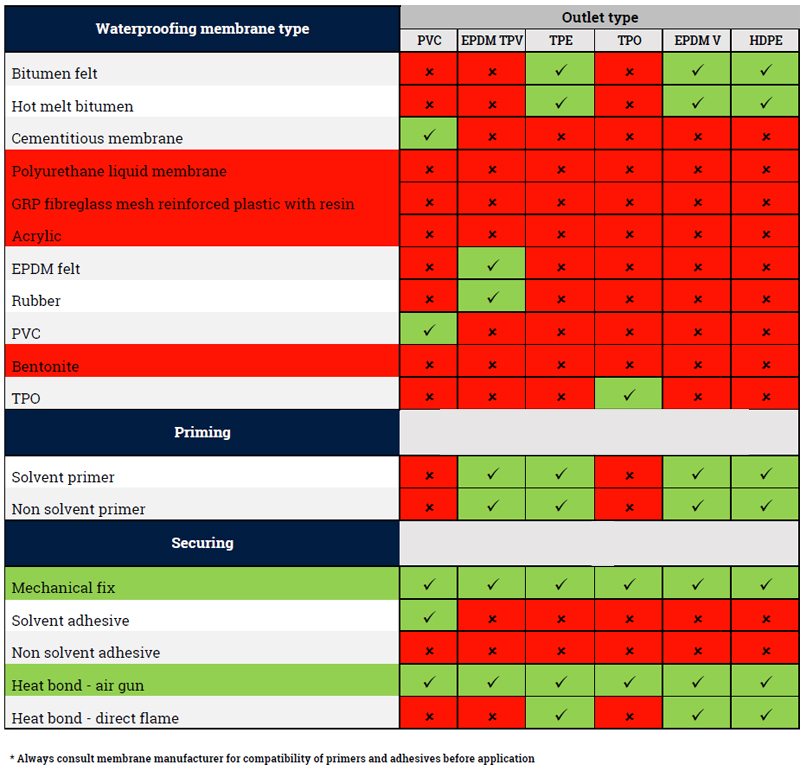
Yes. MiniPads can be installed above suitably protected waterproofing systems.
They are typically loose-laid without adhesive or mechanical fixing, allowing the pedestal system to remain independent of the structural building and avoiding unnecessary penetrations through the waterproofing membrane.
The membrane must be adequately protected against point loading or puncturing before the paving or decking system is installed.
Depending on the project detail, additional pedestal accessories such as acoustic pads, edge plates or other protection components may also be appropriate. The waterproofing manufacturer’s requirements should always form part of the final system specification.
- What material are MiniPads made from and what conditions can they withstand?
MiniPads are manufactured from virgin fibre injection-moulded polypropylene with no fillers.
They are suitable for temperatures from -40°C to +75°C and are resistant to sudden temperature changes, acids, alkalis and salts.
The published fire classification of the polypropylene MiniPad is Euroclass E.
Where a project requires a non-combustible pedestal system, a suitable product should instead be selected from the Wallbarn fire-rated pedestal range.
The MiniPad material specifications and fire classification are detailed in the technical datasheet.
- What maintenance does a MiniPad installation require?
MiniPads themselves require very little direct maintenance once they have been correctly installed.
The main requirement is to keep the gaps between paving slabs or decking boards clear so rainwater can drain freely into the cavity below.
The space between the structural deck and the finished surface should be inspected regularly and at least once each year. During inspection:
- Drainage channels should be kept clear
- Roof outlets should remain unobstructed
- Leaves and debris should be removed
- Combustible material should not be allowed to accumulate
- Any unusual movement in the finished surface should be investigated
Small quantities of debris can be carefully flushed away, provided drainage outlets are not blocked or damaged. More substantial build-ups may require sections of the paving or decking to be temporarily lifted.
Full care and maintenance recommendations are contained within the MiniPad Operations & Maintenance Manual.