Next Day Delivery order before 2pm
 Order / Enquire Now
 Call 020 8916 2222
1. What is the Plastic Pedestal Substructure System?
The Plastic Pedestal Substructure System is an adjustable raised support system designed for suspended paving and decking.
It combines MiniPad or Mega Balance adjustable pedestals with profiled aluminium rails or joists to create a connected framework beneath the finished surface. For paving projects, purpose-designed headpieces are positioned along the rails to support tiles and slabs.
Connecting the individual pedestals through aluminium rails increases lateral stability across the installation and creates a strong, accurately levelled platform for the finished paving or decking above.
Full system specifications are available in the Non-Fire Rated Rail System technical datasheet.
2. What types of projects is the system suitable for?
The system is suitable for a wide range of raised external surfaces, including flat roofs, podium decks, balconies, terraces and walkways.
It can be used on both residential and commercial projects and is particularly useful where a stable suspended surface is required above a waterproofed or structural deck.
Because the pedestal heights and rail profiles can be selected according to the project, the system works well for both new-build schemes and refurbishment projects where existing levels need to be accommodated.
3. Why use aluminium rails as well as individual pedestals?
The rails connect individual pedestal supports together to create a more unified framework.
With standalone pedestals, each support acts independently. Adding aluminium rails ties multiple pedestals together longitudinally, which helps reduce lateral movement and improves stability and alignment across the finished deck.
This connected approach is particularly useful on larger terraces, long balconies, irregular layouts and installations where precise positioning of the finished paving or decking is important.
4. Can the same substructure system support both paving and decking?
Yes. The system has deliberately been designed for both applications.
For paving, adjustable headpieces clip onto the aluminium rails and support porcelain tiles, paving slabs and other suitable units.
For decking, timber or composite boards can be fixed to the aluminium rails or joists using the appropriate mechanical fixing method.
This versatility makes the system particularly useful on projects containing more than one external finish or where the final surface specification may vary between different areas.
5. Which adjustable pedestals are compatible with the system?
The Plastic Pedestal Substructure System is designed around two main pedestal ranges:
- MiniPad, for particularly low build-up heights
- Mega Balance, for larger height ranges and self-levelling applications
Both ranges use purpose-designed clip headpieces that allow compatible Wallbarn aluminium rails to connect securely to the pedestal without requiring additional mechanical fixings at that connection.
More information is available on the MiniPad adjustable pedestal range and Mega Balance self-levelling pedestal range.
6. How low can the Plastic Pedestal Substructure System be installed?
The system has been specifically developed to accommodate low threshold installations.
Using MiniPad pedestals with a 15mm Box Rail, a decking substructure can start from approximately 25mm. For paving rail applications, the published minimum system height is approximately 30mm.
At the other end of the scale, Mega Balance pedestals and suitable rail configurations allow the complete system to accommodate heights exceeding 1 metre.
This wide range makes the system useful for everything from restricted retrofit thresholds to substantially raised terraces.
7. What is the difference between Box Rail and I-Plus Rail?
Both rail types are manufactured from high-grade 6063 T6 extruded aluminium, but they have been designed for different build-up heights and spanning requirements.
Box Rails are available in 15mm, 20mm and 25mm profiles. Their low height makes them especially useful where threshold space is restricted.
I-Plus Rails are available in 50mm, 75mm and 100mm profiles. Their deeper construction provides greater structural capability and allows larger spans between supporting pedestals where the project requires it.
The individual profiles can be explored through the I-Plus Rail range and Wallbarn’s Box Rail product information.
8. How far can the aluminium rails span between pedestals?
The permitted spacing depends on the rail profile selected and the loading requirements of the project.
The deeper I-Plus profiles have been developed to achieve considerably greater spans than the low-profile Box Rails. On the current product specification, recommended maximum support distances extend up to 1,800mm for the 100mm I-Plus Rail, while lower-profile rails require more frequent support.
Rail spacing should always be selected according to the relevant profile, surface finish, expected loading and project design rather than applying one spacing across every installation.
Independent load and deflection information is included in the Non-Fire Rated Rail System technical datasheet.
9. How are paving slabs supported on the aluminium rails?
A purpose-designed paving headpiece clips directly onto the aluminium rail and can slide along it until it aligns with the edge or corner of the paving unit.
Integrated lugs hold adjacent tiles or slabs in position while maintaining an open joint for drainage.
Standard paving headpieces are available with 2mm or 4mm-wide lugs, with the lugs measuring 10mm high. Additional options are available for certain applications.
The adjustable position of the headpiece is particularly useful for accurately supporting different paving layouts without being restricted to the exact location of the pedestal below.
10. What types of paving can be installed on the system?
The system is designed for suitable suspended porcelain tiles, porcelain planks, concrete paving slabs and flags.
The published technical information identifies it as particularly suitable for 20mm porcelain paving, while the rail-based arrangement can also provide additional support for longer-format porcelain units and planks.
As with any suspended paving installation, suitability should be confirmed by considering the dimensions, thickness and strength of the paving together with the intended loading and support layout.
11. How is decking fixed to the aluminium rail system?
For decking installations, boards are mechanically fixed to the aluminium rails or joists.
The rails should be pre-drilled before fixings are installed, and high-grade stainless-steel fixings are recommended to minimise the risk of galvanic corrosion between the fixing and aluminium substructure.
The aluminium framework provides a stable alternative to conventional timber joists and will not warp, splinter or decay through exposure to moisture.
The complete installation recommendations can be found in the Non-Fire Rated Rail System Operations & Maintenance Manual.
12. Is the system suitable for self-levelling applications?
Yes. Mega Balance pedestals are supplied with a self-levelling headpiece as standard.
The pedestal can accommodate substrate falls of up to 5%, helping maintain a level upper rail and finished surface while the structural deck beneath retains the fall required for drainage.
Where a fixed-head arrangement is more appropriate, the Mega Balance head can also be locked using the Grey Nut accessory.
This dual-purpose design allows the same pedestal family to accommodate different details across a project without requiring a completely different support system.
More information is available on the Mega Balance product page.
13. Can the system be installed over waterproofing membranes or insulation?
Yes, provided the complete roof build-up is suitable for the proposed loading.
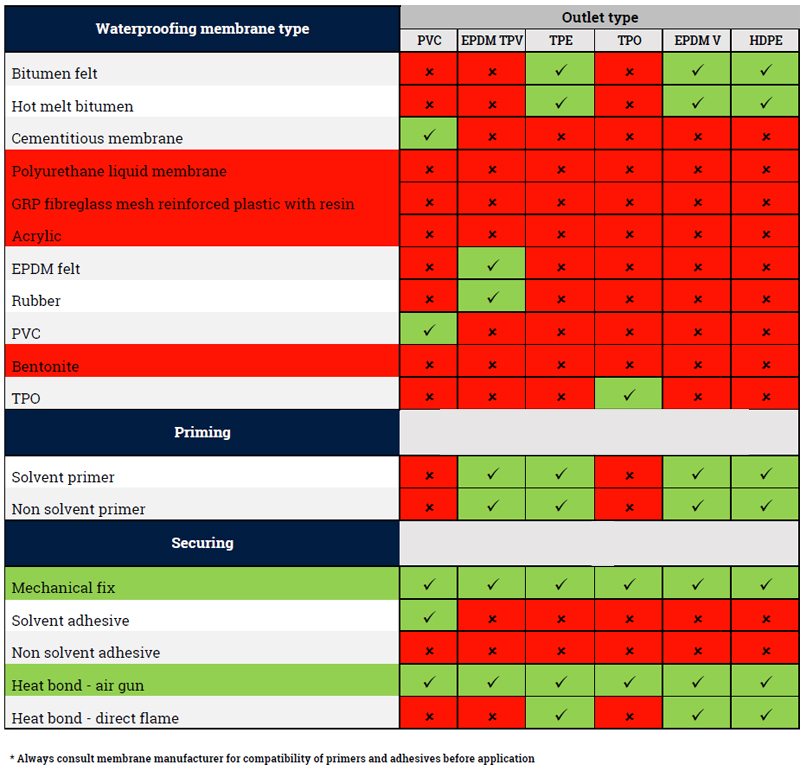
Waterproofing membranes should be adequately protected before installation to reduce the risk of puncturing or concentrated point loading.
Where the system is installed over insulation or another compressible surface, the manufacturer of that material should confirm that it has sufficient compressive strength for the proposed pedestal spacing and loading.
The rail layout and pedestal positioning should therefore be considered alongside the waterproofing, insulation and structural deck rather than treating each element independently.
14. Is the Plastic Pedestal Substructure System Class A fire rated?
The aluminium Box Rails and I-Plus Rails themselves are classified Class A1 to BS EN 13501-1:2018. However, the Plastic Pedestal Substructure System as a whole should not be described as a Class A system because it incorporates polypropylene pedestal and headpiece components.
The MiniPad and Mega Balance plastic pedestal components have published Euroclass E classifications.
Where a project specifically requires a fully non-combustible support system, the appropriate alternative is Wallbarn’s Class A Rail Substructure System using fire-rated metal pedestal components.
This distinction allows the correct system to be selected according to the actual fire strategy and building specification.
15. Has the system been independently tested and what maintenance does it require?
Yes. The aluminium Box Rail and I-Plus components have been independently tested by Specialist Technical Services (UK) Ltd for span, load tolerance and deflection performance. The published testing includes assessment in accordance with BS 8579:2020, using a 5mm deflection criterion for rail support spacing.
The use of additional noggins can further increase the stability and load-bearing performance of the rail framework. Published testing recorded an improvement of more than 40% in one tested I-Plus configuration.
Once installed, the system has relatively low maintenance requirements. The principal requirement is to keep drainage channels and outlets clear and prevent standing water or debris from accumulating beneath the finished surface.
The published system guidance provides a 15-year limited performance warranty and an expected lifespan of up to 30 years, subject to correct specification, installation, use and maintenance.
Full care and warranty information is available in the Non-Fire Rated Rail System Operations & Maintenance Manual.