Next Day Delivery order before 2pm
 Order / Enquire Now
 Call 020 8916 2222
[fusion_builder_container hundred_percent=”no” equal_height_columns=”no” menu_anchor=”” hide_on_mobile=”small-visibility,medium-visibility,large-visibility” class=”” id=”” background_color=”” background_image=”” background_position=”center center” background_repeat=”no-repeat” fade=”no” background_parallax=”none” parallax_speed=”0.3″ video_mp4=”” video_webm=”” video_ogv=”” video_url=”” video_aspect_ratio=”16:9″ video_loop=”yes” video_mute=”yes” overlay_color=”” video_preview_image=”” border_size=”” border_color=”” border_style=”solid” padding_top=”” padding_bottom=”” padding_left=”” padding_right=””][fusion_builder_row][fusion_builder_column type=”1_1″ layout=”1_1″ background_position=”left top” background_color=”” border_size=”” border_color=”” border_style=”solid” border_position=”all” spacing=”yes” background_image=”” background_repeat=”no-repeat” padding_top=”” padding_right=”” padding_bottom=”” padding_left=”” margin_top=”0px” margin_bottom=”0px” class=”” id=”” animation_type=”” animation_speed=”0.3″ animation_direction=”left” hide_on_mobile=”small-visibility,medium-visibility,large-visibility” center_content=”no” last=”no” min_height=”” hover_type=”none” link=””][fusion_text columns=”” column_min_width=”” column_spacing=”” rule_style=”default” rule_size=”” rule_color=”” hide_on_mobile=”small-visibility,medium-visibility,large-visibility” class=”” id=””]
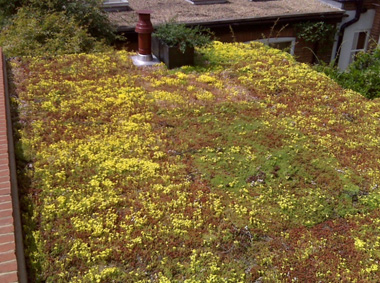
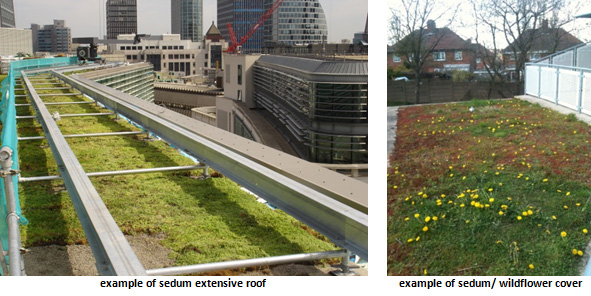
Extensive green roofs are a lightweight and most low maintenance type of green roof system. They consist of hardy, succulent green plants installed so as to provide the simplest way to green flat roof structures in urban environments, and thus help to bring nature into the cities. They are a useful and every possible way to improve the aesthetics of often very stark and ugly flat roofs.
Extensive green roof systems usually consist of sedum
Extensive green roofs are often used on new build developments but can also be used very effectively as retro-fit enhancements to existing flat roofs and podium decks.
Being comparatively lightweight, at typically 80kg per m2 (saturated weight) they can be used on a large variety of structures.
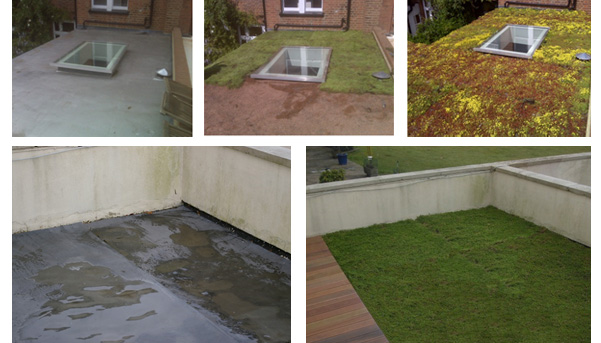
Sedum extensive green roof systems can often be installed on areas where full roof gardens could not be contemplated. Please see some case studies here. Because they are designed to be hardy and not require regular irrigation or maintenance, vast areas on rooftops and podium decks can be greened, which if replicated across a city or district, can radically change the whole aspect of cityscapes.
FEATURES OF EXTENSIVE GREEN ROOF SYSTEMS
The main features of extensive green roofs are:
- Lightweight – systems can be as light as 50kg per m2
- Total build-up depth – 100 – 150mm thick
- Simple vegetation – mainly sedum or sedum/wildflower mixes
- Vegetation requires very low levels of nutrients
- Use aggregate based growing medium/substrate
- Drought tolerant
- Saline tolerant
- Low maintenance requirement
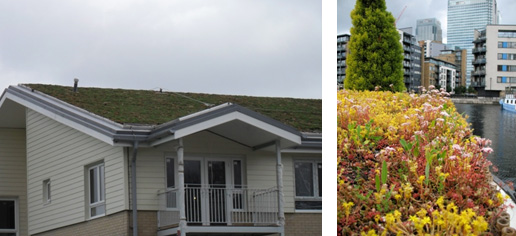
Wallbarn has supplied extensive green roofs for some varied structures over the years, including a houseboat (featured below) in London.

Please click here to see the whole story.
INSTALLATION

Extensive green roof systems are built up in individual layers from the waterproofed deck or insulation layer (in the case of inverted roof systems). This system of installation is often called the component or roll-out system of installation.
Each component of the system is supplied separately.
The sedum blankets are rolled up carefully, the filtration and separation layers are supplied in rolls and the substrate is supplied in bags.
These are packed onto pallets for delivery to site.
The build-up of each element (from the waterproofed deck upwards) is made up as follows:
- Wallbarn recycled polyester geotextile filter fabric. Wallbarn supplies a range of different geotextile fabrics and we recommend a fabric of at least 300gsm – code PEC-0300-Z.
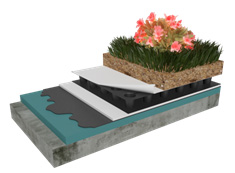 Protecto-drain. This is a flexible, cuspated and perforated HDPE membrane. It is available in various sizes – 8mm, 20mm or 60mm, depending on drainage/water attenuation requirement. This is loose laid onto the geotextile, cup-side up and overlapped at the edges of the sheets (60mm membrane is supplied in rigid trays and clipped together). This membrane collects a certain amount of water but also allows excess water to escape through the perforations into the roof outlets.
- Another layer of Wallbarn recycled polyester geotextile filter fabric, to allow water to pass through the system but to prevent substrate particulates from blocking the drain.
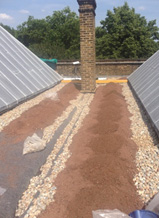 The lightweight engineered substrate, supplied in bags, is spread out onto the geotextile fabric. This substrate mix is specially blended by Wallbarn and is manufactured from a mix of crushed aggregate, expanded clay pellets, Microlot TM and green waste to form a gritty mineral based low nutrient growing medium. It is important to get the consistency and nutrient levels correct to prevent waterlogging, to optimize the root structures of the sedum and to reduce to a minimum the number of invasive plants and seeds from colonizing the area.
- The sedum blanket is then rolled out onto the substrate and gently pressed into place. If plug plants or seeds are to be used, then they are planted and distributed over the surface at this point. The most common type of extensive green roof is the sedum mix blanket. However, Wallbarn also has a sedum/wildflower mix blanket for use in extensive green roof systems as a standard item. These blankets can also be plug planted with herbs and certain dwarf plants to add variety to the roof finish.
Parapets and upstands need to be kept clear of vegetation and this can be done with rounded riverstone pebbles, paving slabs or simply left clear.

Where there is an exposed edge with no parapet, a perforated aluminium angle can be used to provide an edge to the green roof itself.
THE PLANTS
The sedum plants we use have been selected to be easy to manage and do not need a large amount of watering, making them ideal for areas which may be overlooked but are difficult to access and maintain.

Our sedum blankets have been grown on our nursery for at least nine months and are grown from a mixture of at least six different species of sedum. This ensures a consistent, all year round coverage of vegetation, with some plants providing colour changes and textures throughout the year. The flowering period is generally June to July.

Mixes of wildflowers, herbs and bulbs can also be incorporated into the blankets. We supply healthy, freshly cut sedum blankets with at least 85% coverage. Please click here for more details on our sedum blankets and nursery.